.png)

.png)




The Risk
The first time we met she was part of a Japanese business delegation to my city of Kraków. We had a fling and continued writing after she left. She was everything I needed then. The slow-burn long-distance was a wonderful way of not being overwhelmed. I did not have deep feelings in the beginning, but I thought that love will come once we spend more time together. Affording time together was difficult and costly but we both agreed that it was worth a try.
After we had spent our first week together, I felt there was a biological or physical problem of love. Not what you think, no. My subconscious or whatever would not let me feel love and I hated myself for it. I tried to argue with myself, but it would not do. She was wonderful, she really was. But my subconscious wasn’t playing along. It felt greedy to want more. As if she wasn’t enough. Yet, at the thought we might never meet again, I felt genuine fear. I couldn't stop crying and, at this moment, I realized that I cared for her deeply. It was a terrible, bastardized emotion that relied on fear to manifest. But while this emotion was twisted and uncomfortable, it convinced me we had a real chance.
The Promise
After a vacation weekend full of bad tempers, she said "kocham cię" for the first time. I thought she had figured something out, that she knew something I didn't. I did not know she just said it because the weekend had sucked, and she had needed something to hold on to. Although I didn't feel anything, I said it back: "Aishitemasu." She had confessed her love it in Polish and I had confessed mine in Japanese, thus both of us were able to relief the weight of untruth onto the other one’s language. We were lying in bed, both having said more than we wanted to. Later, when we exchanged love words in our own language, I had to give them a meaning that was true. I created the rule that "I love you" means: A promise to care for each other until death. The until-death component is important, it differentiates the words from simply saying: I care for you.
The Fantasy
When I went to Nagoya, she was mostly busy. I felt like a prisoner in her small living room. Travelling between our countries was expensive and left me with insufficient funds to go out. Every time the lonely question of what I was doing here became unbearable, I repeated the mantra: I suffer for love. This was true by my definition love: I cooked for her, dusted her apartment, fed her songbird. I cared for her. Thus, her apartment became a sphere of my love.
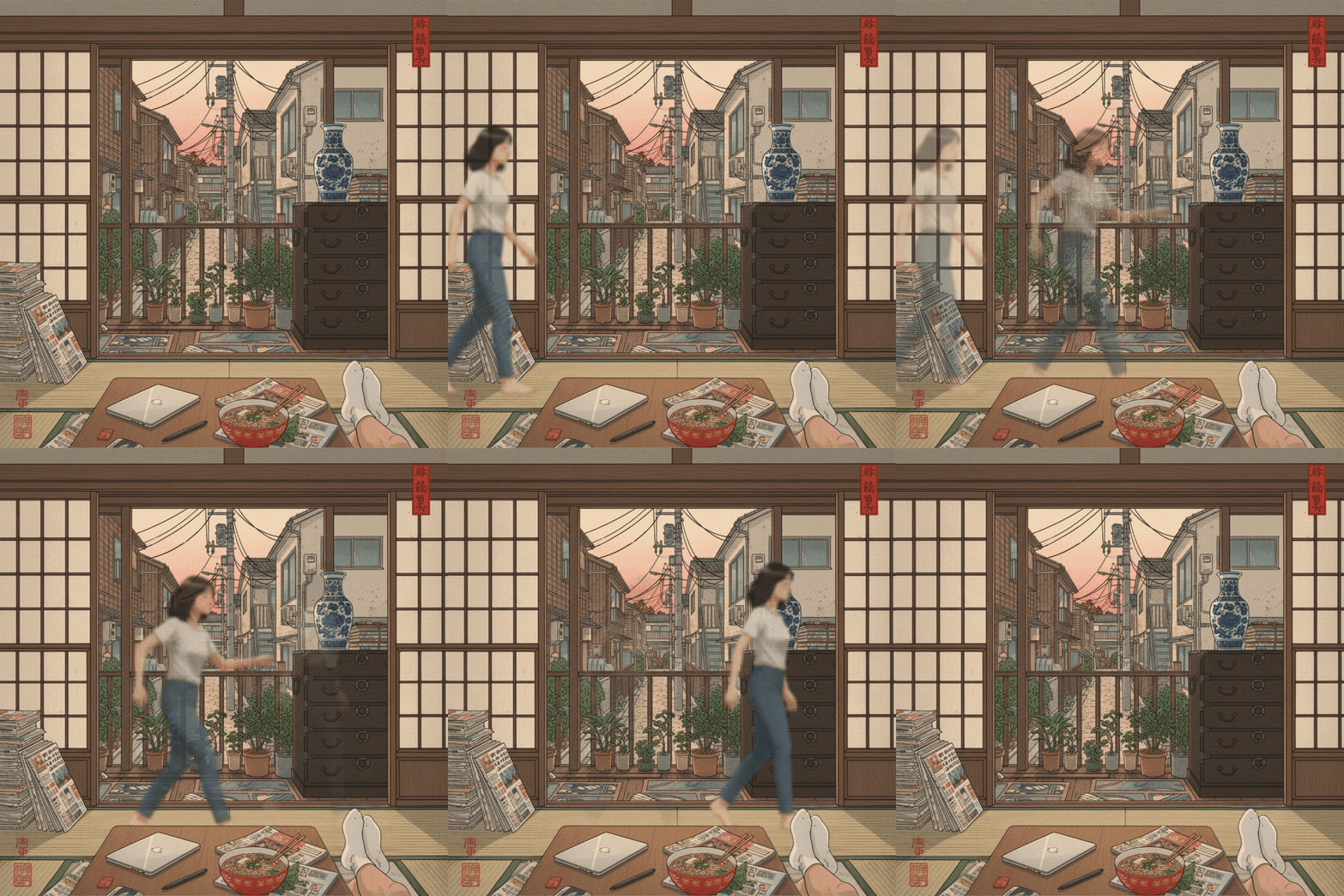
And there was this vase. She had seen it back in Krakow and had let me promise to bring it. Happy, she had set the vase on her beautiful Japanese dresser. It was simple and elegant, like a bridge between our countries made of wood and clay. I dusted it every day but never found fitting flowers that could do the beauty of this arrangement justice.
Over the following weeks I developed a play in my head that I was an imprisoned foreign ambassador of the countess. I was the man in the iron mask. In nightly inquisitions the countess came and interrogated me. She tried to squeeze out the truth with her mouth and her bidding. Of course, the ambassador was in love with the countess, but the loyalty to his country was equally strong. And if only she truly looked away from him onto that beautiful arrangement of vase and dresser, she would realize his whole inner devotion to her. The altar of my inside-out love. But she could never see. (I wanted to explain it. But explaining things takes all life out of them. A description kills the subject of contemplation. Never she could see.)
The Secret
The next time she visited, we often fought. When I came home late in the evenings, I was exhausted. And she had raised a monster every day and let it run wild. Petty proxies grown in the echo chamber of her head. And after half an hour they all found their common ground in her insecurity. She felt that I had a secret. She knew that I was circling something. She sensed the carefulness in my words and thought I was being untrue. I am unable to lie. I talked like an ambassador, because every word could be misunderstood. I was a Polish state ambassador, she was a Japanese countess, carefully keeping the balance between our countries. I prayed that the countess would force me to admit that I did not love her. No, she couldn’t. She was too afraid! At the same time, I held on to the childish hope that if I explained it correctly, she would say: You idiot, all that questioning, that unsureness: That is love! – and suddenly, it would be so.
The Rule
Shortly before the end of our relationship we got into arguments over feminism. Neither of us were invested in the issue, yet we argued. She said that men (especially me) were entitled. I said that men grew up entitled and some of us try very fucking hard not to be. For me, the conflict boiled down to "I want more" versus "Can I accept less?" When women want more, they want equal. A perspective I envy because it gives women an external fight. Men, however, are faced with accepting less. All their lives men have been promised the world and now they won't get it. This is an internal fight of acceptance. A fight they are unequipped for because they have been raised lacking emotional literacy. Instead, men let proxies govern their inner lives, proxies give them order and manage their disappointments. They create rules to translate their confusion into coherence. Feelings are translated into something tangible. Rules to care until death.
The Lie
The Polish Ambassador lost all diplomatic connections to the state of Japan, graciously represented by one stateswoman. One last tear-filled phone call, the shit finale of a shitshow of a crescendo of a rule I invented because she had said “kocham cię” after a shit weekend and I was too fucking afraid to not say the same thing. I had cried many tears that all turned into love, terrible, terrible love. We would not see each other again. There was no reason. We weren’t really ambassadors and blue-blooded statewomen. The exact moment the relationship ended, I understood. Right there, real wet love surfaced, certainty, that I had loved her. I had to think of the man in the iron mask. It itched me that we don’t know who the prisoner was. I felt entitled to know the truth beyond literary speculation. It made me think: Was a secret fulfilled when it was held or when it was spilled? Then, I wondered if she kept the vase. If my still-life still stood in the Nagoya morning sun. Maybe one morning she will wake up and see it.
Discover More Classic Schmalk!


.png)
Minister Long Schlong Takes a Stand
.png)